
Influence
The Psychology of Persuasion

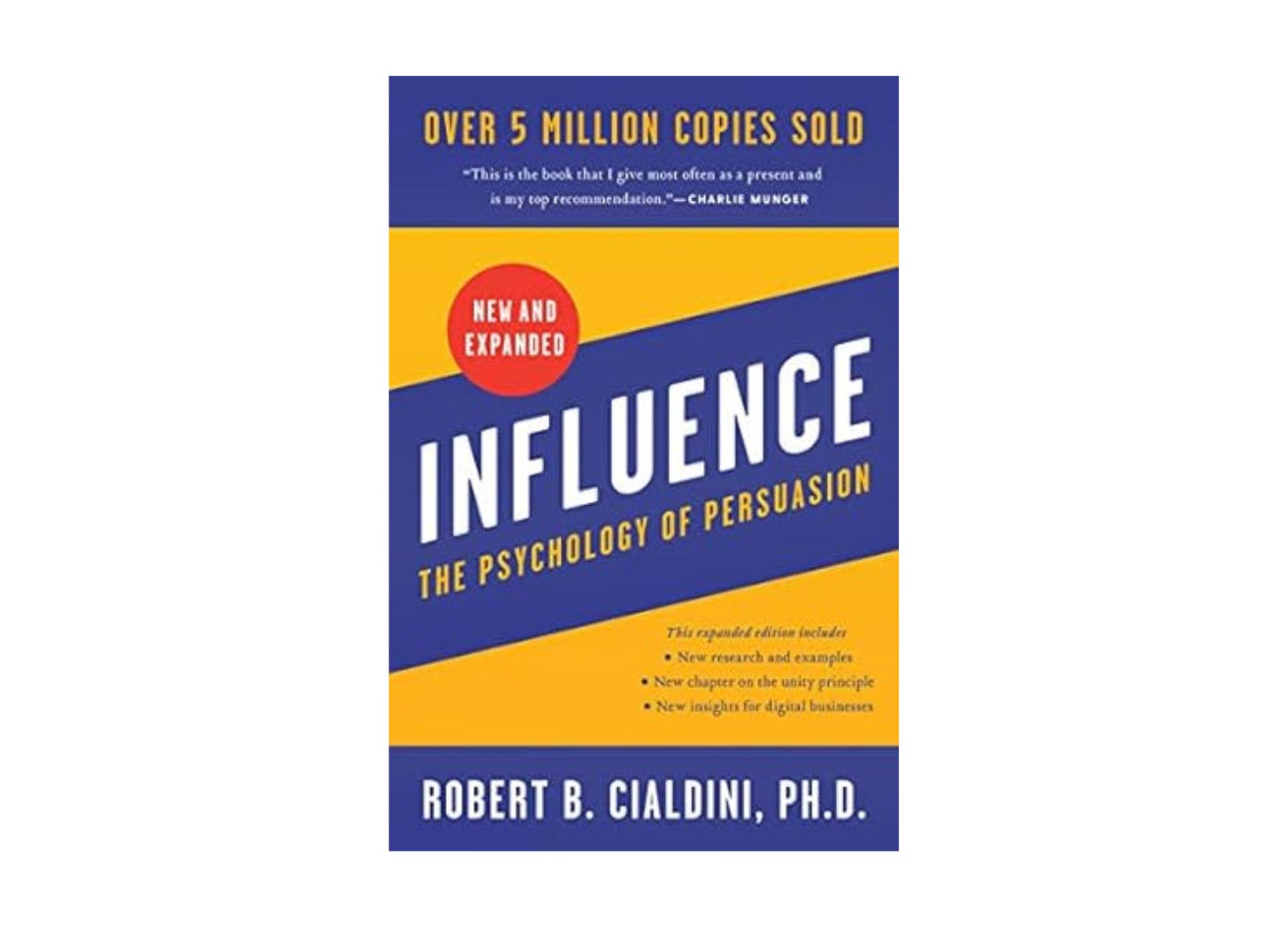
Influence: Exploring Robert B. Cialdini's Principles of Persuasion
"Influence" by Robert B. Cialdini delves into the psychological principles that govern how we influence and are influenced by others. These principles include reciprocation, liking, social proof, authority, scarcity, commitment and consistency, and unity. Understanding these principles helps us recognize why people comply with requests and how we can use these insights ethically in various fields like marketing, politics, and social interactions.
Overview
This summary outlines the seven principles of influence identified by Cialdini: reciprocation, liking, social proof, authority, scarcity, commitment and consistency, and unity. Each principle will be explained in detail, demonstrating how it elicits compliance and its real-world applications. Additionally, we will explore the ethical considerations and broader implications of these principles on behavior and decision-making.
Reciprocation
Reciprocation is the principle that people feel obligated to return favors. This is a fundamental social norm observed across cultures and can be used to influence behavior effectively.
Obligation to Return Favors - When someone does something for us, we feel a strong urge to return the favor. This sense of obligation is deeply ingrained in our social interactions, stemming from an innate desire to maintain social balance and fairness. The feeling of indebtedness can be so powerful that it often compels individuals to act, even when the favor received was unsolicited or unexpected.
Universal Social Norm - The principle of reciprocation is found in virtually every culture, highlighting its importance in human social behavior. From ancient societies to modern communities, the act of giving and receiving is a pivotal part of social exchanges. This universality underscores the evolutionary and psychological underpinnings of reciprocation, suggesting it plays a critical role in fostering cooperative relationships and social cohesion.
Effective in Various Contexts - Reciprocation can be used in numerous contexts, such as marketing, diplomacy, and everyday interactions. In marketing, free samples are a common tactic; when customers receive a free sample, they often feel a subtle pressure to reciprocate by purchasing the product. In diplomacy, gift exchanges are a strategic tool to build goodwill and strengthen alliances. In everyday life, simple acts of kindness, like helping a neighbor, can foster a sense of community and mutual support.
Liking
People are more likely to comply with requests from those they like. Several factors increase liking, including physical attractiveness, similarity, compliments, and repeated contact.
Physical Attractiveness - Attractive people are generally liked more and thus are more persuasive. This phenomenon, often referred to as the "halo effect," suggests that physical beauty can lead to the perception of other positive traits, such as intelligence, kindness, and capability. As a result, attractive individuals often find it easier to influence others and achieve compliance.
Similarity - We tend to like and be influenced by people who are similar to us in terms of interests, background, and values. This similarity creates a sense of connection and understanding, making us more receptive to their ideas and requests. Whether it's sharing a hobby, a hometown, or a worldview, common ground fosters trust and likability.
Compliments and Repeated Contact - Compliments make us feel good and more inclined to agree with the person giving them. Genuine praise can boost self-esteem and create a positive association with the compliment-giver. Repeated contact, on the other hand, fosters familiarity and liking. Known as the "mere exposure effect," this principle suggests that the more we see or interact with someone, the more likely we are to develop a fondness for them.
A practical example of these principles at work can be seen in sales. A salesperson who finds common interests with a customer and offers sincere compliments will likely close more sales. By establishing rapport through shared experiences and positive reinforcement, the salesperson becomes more likable and trustworthy, increasing the chances of the customer making a purchase.
Social Proof
Social proof is the principle that individuals look to the behavior of others to determine what is correct. This is particularly powerful under conditions of uncertainty and when the behavior is exhibited by similar others.
Behavior of Others as a Guide - People tend to follow the actions of others. When we are unsure of how to behave, we look to those around us for cues. This herd mentality helps us make decisions more easily by relying on collective behavior as a benchmark for appropriate conduct.
Effectiveness in Uncertainty - In uncertain situations, individuals are more likely to mimic the behavior of others. Uncertainty can arise from a lack of information, new environments, or ambiguous scenarios. In such cases, observing and copying others provides a sense of safety and correctness, reducing anxiety and the risk of making a wrong choice.
Impact of Similar Others - We are more influenced by people who are similar to us in some way. Whether it’s shared demographics, interests, or experiences, we trust the actions of those who we perceive as relatable and similar to ourselves. This similarity reassures us that if it worked for them, it will likely work for us too.
User reviews and testimonials are powerful examples of social proof. They show that many people have had positive experiences with a product, which in turn encourages others to try it. When potential customers see numerous reviews from people like themselves praising a product, they feel more confident in their decision to make a purchase. This collective endorsement acts as a persuasive force, leveraging the power of social proof to drive behavior and choices.
Authority
People tend to comply with authority figures. Symbols of authority, such as titles, uniforms, and trappings, can also trigger compliance.
Compliance with Experts - Individuals are more likely to follow the advice of experts or authority figures. Expertise implies knowledge and credibility, making people feel safer and more confident in acting upon their guidance. This trust in authority is rooted in the belief that these figures have more information or better judgment than the average person.
Symbols of Authority - Titles (Dr., Professor), uniforms, and other trappings of authority can enhance compliance. These symbols serve as visual cues that signify power and expertise, automatically generating respect and obedience. For instance, a doctor's white coat, a police officer's uniform, or an executive's business attire all convey authority and can prompt people to comply without questioning.
Real-World Applications - Doctors, lawyers, and other professionals use their authority to persuade clients and patients. Their qualifications and professional attire reinforce their authority, making it easier for them to gain compliance and trust. This dynamic is crucial in various fields where expert advice or directives are critical for decision-making and action.
A classic example of authority's power is the Milgram experiment, where participants were willing to administer what they believed were painful electric shocks to others because they were instructed to do so by an authority figure. This experiment highlighted the extent to which people are willing to obey authority, even to the point of causing harm to others, underscoring the profound influence that authority figures can wield over individual behavior.
Scarcity
Scarce items are perceived as more valuable. The fear of missing out or losing something is a powerful motivator.
Increased Perceived Value - Limited availability makes items seem more valuable. When something is in short supply, people tend to assign it a higher value, believing it to be more desirable and exclusive. This perception of rarity can significantly boost an item's appeal.
Fear of Missing Out - People are motivated by the fear of missing out on something exclusive. Known as FOMO, this fear can drive individuals to take immediate action to avoid losing the opportunity to acquire something rare or time-sensitive. The urgency created by scarcity can spur quicker decisions and stronger impulses to obtain the item in question.
Applications in Marketing - Limited-time offers and exclusive products capitalize on this principle. Marketers often use scarcity tactics to create a sense of urgency and exclusivity. Flash sales, countdown timers, and phrases like "only a few left in stock" or "offer ends soon" are designed to tap into consumers' fear of missing out, encouraging them to act fast.
A prime example of how scarcity drives consumer behavior is seen in Black Friday sales. Retailers create a frenzy by offering significant discounts for a limited time, often with a finite amount of stock. The combination of limited availability and time-sensitive deals leads to a surge in consumer demand, illustrating the power of scarcity in motivating purchasing decisions.
Commitment and Consistency
Once individuals commit to something, they are more likely to act in ways consistent with that commitment. Public commitments are particularly strong and reinforce the principle of consistency.
Power of Small Commitments - Small initial commitments can lead to larger commitments over time. When individuals agree to a minor request, they are more likely to comply with larger requests later. This gradual escalation makes people feel invested and consistent with their previous actions.
Public Commitments - Publicly committing to a decision strengthens the likelihood of following through. When people make commitments in front of others, the social pressure to appear consistent increases. This public declaration serves as an additional motivator to stick to the commitment, as failing to do so could lead to a loss of face or credibility.
Behavioral Consistency - People strive for consistency in their actions and beliefs. Once they have committed to a course of action, they often adjust their attitudes and behaviors to align with that commitment. This drive for internal and external consistency helps maintain a coherent self-image and avoid cognitive dissonance.
An example of this principle in action is the "foot-in-the-door" technique. This involves making a small request first, which the individual is likely to agree to, followed by a larger request. For instance, if a charity asks someone to sign a petition (a small commitment), they are more likely to donate money later (a larger commitment). By agreeing to the initial request, individuals feel a sense of obligation and consistency that makes them more amenable to the subsequent, larger request.
Unity
Shared identities and a sense of belonging to the same group increase compliance. This can be based on kinship, nationality, shared experiences, and more.
Shared Identity - A sense of belonging to the same group fosters unity and compliance. When individuals identify with a group, they are more likely to align their behaviors and decisions with the group's norms and values. This sense of unity strengthens group cohesion and collective action.
Kinship and Nationality - People are more likely to comply with those they perceive as part of their group. Kinship ties and national identity are powerful drivers of unity. Individuals often feel a stronger obligation to support and comply with requests from family members or fellow citizens, as these relationships are based on deep-rooted connections and shared loyalties.
Shared Experiences - Common experiences and backgrounds enhance a sense of unity. Whether it's surviving a challenging event, attending the same school, or working in the same industry, shared experiences create bonds that increase mutual understanding and cooperation. These shared experiences make it easier for people to relate to and support one another.
Political campaigns often emphasize common national or regional identities to garner support. By highlighting shared values, traditions, and goals, politicians can create a sense of unity among voters. This strategy fosters a collective identity, encouraging individuals to support the campaign and its objectives as part of their commitment to the larger group.
Conclusion
"Influence, New and Expanded" by Robert B. Cialdini offers a comprehensive exploration of the principles of influence. These principles are powerful tools in shaping behavior and decision-making. Understanding these principles can enhance one's ability to influence others ethically and recognize when they are being influenced. The book invites further exploration into the psychological mechanisms behind human behavior and the ethical use of influence. These principles help us navigate social interactions more effectively and protect ourselves from manipulation.
Discussion Point
Question: What are the contextual factors that alter the effectiveness of different influence principles?
Answer: The effectiveness of different influence principles is significantly altered by various contextual factors including the nature of the social or professional environment, the existing relationship between the influencer and the target, cultural norms, and the specific goals of the interaction. For instance, in a professional setting, authority and expertise might play a more substantial role, whereas, in social settings, liking and social proof could be more influential. Cultural differences also impact which principles are more effective; for example, collectivist cultures might place more emphasis on unity and social proof, while individualistic cultures might prioritize authority and scarcity. Additionally, the immediate goals of the influencer, such as relationship building versus motivating action, will dictate which principles should be prioritized.
For instance, in a hierarchical corporate environment, an employee might comply more readily with a request from a supervisor due to the authority principle, whereas in a flat organizational structure, social proof and commitment might be more effective.
Recognize that even within broad cultural categories, there are significant variations. For example, within the U.S., regional differences (e.g., Midwest vs. East Coast) can influence which principles are more effective.
High-trust relationships might make principles like liking and unity more effective, while in low-trust relationships, scarcity and authority might be more compelling due to the lack of interpersonal connection.
Further Reading/Resources
"Pre-Suasion" by Robert Cialdini: Explores how to set the stage for influence before the actual attempt to persuade.
"Nudge" by Richard Thaler and Cass Sunstein: Discusses how small changes in the environment can significantly impact decision-making.
"Thinking, Fast and Slow" by Daniel Kahneman: Provides insights into the two systems of thinking and how they influence our decisions.
"The Power of Habit" by Charles Duhigg: Examines the science behind habits and how they can be changed.